The AI CEOs want you to hate AI (unless you love it)
An opinion piece / rant about AI, open source, a dim outlook on the future, and how you can brighten it. AI is simultaneously worse and better than you think, and complaining about water is what the billionaires want you to do.
Well, I’d like to say I am not an expert, in anything, by any means. This is simply a way of putting my thoughts in a more structured form, as this has been coming up a lot recently. This isn’t even original thought, everything I am saying has been thought of by others before me, I just have never seen this argument all in a single document, though maybe I just haven’t looked hard enough or in the right places.
I would also like to say this was written 7/24/2026. Things are moving so fast this may end up completely incorrect in a year. I will update this if that occurs, but obviously by this text being here it hasn’t been updated since then.
Some required vocabulary
I do not yet make any claims about any of these being plausible things that could occur, I am simply defining some terms so that you can understand what I’m talking about.
For the purposes of this post, the word AI will almost always refer to LLMs or their hypothetical descendant technologies (world models, neurosymbolic AI, whatever the industry goes with). Not direct “AI” media generation, as that’s rather unrelated.
AI Alignment: The problem that an AI should follow what you tell it to, but also shouldn’t do bad things if you tell it to. An AI that does these things is “aligned” but it’s “aligned” to whoever defined what good and bad was, which might not be a very good definition depending on who did that (see: Grok).
Weights: The big black box of numbers that makes up an AI model. Think of it like the file it’s stored in.
AGI - Artificial General Intelligence: An AI (or AI powered system) that can do any “economically valuable” work a human could do given access to the same tools. Just simply do, not necessarily more effective, faster or cheaper.
TED AI - Top Expert Dominating AI: An AI (or AI powered system) that can do any “economically valuable” work at or above the level of top human experts of the field in most fields. Not necessarily faster or cheaper than said human expert, but it would be hard not to be. Still within human understanding.
ASI - Artificial Super Intelligence: An AI (or AI powered system) that is more intelligent than the best humans by a large amount (how large the large amount is varies by who you ask, let’s just say 2x, whatever that means). Could be within human understanding, or could not be, or could depend on when you peek at it, nobody really knows what it’ll look like!
RSI - Recursive Self Improvement: The idea that if an AI could become better at AI research and development than humans, it would be able to improve itself recursively. How far this can go is very debatable (and read the rest of this blog and you’ll see it doesn’t really matter).
Machine God: A specific prediction of what an ASI would look like. That an ASI would inherently be able to do RSI and that it would lead to an ASI far beyond human understanding, and that the machine god would be able to develop technology indistinguishable from magic. ANY slight misalignment could potentially lead to those values being “locked in” as humans would stand no chance to shut it down if it resisted shutdown.
Singularity: The moment in time in which RSI starts occurring leading to an extreme advancement in technology. This is generally believed to be an extremely high tension and risky moment, with high risk of existential harms or human extinction.
Artificial Analysis Intelligence Index: A weighted average score of a bunch of benchmarks. This can only be used to compare different AI models to each other, not to humans. The score is non linear weighted average based on a changing set of benchmarks and isn’t super useful for comparing old models to new models like I use it to do. I do this knowing it’s a poor idea because there is no better alternative, and it is still leagues better than saying “this is several times better than that” with literally zero evidence. Measuring intelligence is HARD and mostly qualitative, even with computers.
What do the AI CEOs actually think about the future of AI?
Most of the people in the AI space, especially those up top, generally believe in a few things about AI:
- AGI is soon if it has not already happened
- RSI is probably possible
- The Singularity is probably real
- Those will most likely lead to a machine god (if they happen)
- All of this has a massive risk of human extinction or mass casualties.
Now, you’re probably not gonna believe me that they really think those things, since “The Billionaires are spending billions just to end the world and are blatantly saying it out loud!” is a crazy person take. So, here’s what the CEOs say:
“I think that AI will probably, most likely, sort of lead to the end of the world. But in the meantime, there will be great companies created with serious machine learning.” - Sam Altman, CEO of OpenAI in a 2015 interview. (https://futureoflife.org/ai/sam-altman-investing-in-ai-safety-research/)
“I am concerned that LLMs are approaching (or may already have reached) the knowledge needed to create and release [biological weapons] end-to-end, and that their potential for destruction is very high. Some biological agents could cause millions of deaths if a determined effort was made to release them for maximum spread.” - Dario Amodei, CEO of Anthropic in an essay on his own website in January 2026. (https://darioamodei.com/essay/the-adolescence-of-technology)
Elon Musk signed the Pause Giant AI Experiments open letter, which called for a 6 month pause on AI development while regulation restricting its development was passed. (This could have just been an attempt at regulatory capture, more on that later.) (https://futureoflife.org/open-letter/pause-giant-ai-experiments/) (There’s probably like a billion tweets I could use as evidence here too, whatever…)
This isn’t super definitive evidence or anything, but hopefully it’s enough for you to look into it a bit more yourself. The reason I brought this up was because I want to contrast it with their actions. So:
What’s going on in AI anyways?
I think a brief bit of history is required to understand what I’m saying, so here’s a timeline, no need to memorize it since the important parts will be referenced again later, but you should still read it.
- June 2017: The paper “Attention Is All You Need” is published, this formalized the transformer architecture used in almost all LLMs.
- June 2018: OpenAI GPT 1 is released.
- February 2019: OpenAI GPT 2 is released, along with all the drama that entailed.
- November 2019: OpenAI GPT 2 full is released.
- May 2020: The paper for OpenAI GPT 3 is released.
- June 2020: Restricted access for GPT 3.
- January 2021: Anthropic is founded by OpenAI refugees on concerns OpenAI isn’t taking AI alignment and safety seriously enough.
- November 2021: GPT 3 Public commercial access (Paid API) is released.
- November 2022: ChatGPT releases, running GPT 3.5 turbo-preview.
- March 2023: Meta Llama 1 weights leak to the internet, resulting in the start of a lot of the modern open LLM community.
- March 2023: OpenAI GPT-3.5 turbo API releases to the public, scoring a 4 on Artificial Analysis, marking the first time a public model could use external tools.
- March 2023: Anthropic Claude 1 releases in private access.
- March 2023: OpenAI GPT-4 releases to the public, scoring a 7 on Artificial Analysis.
- March 2023: The first death directly attributable to the actions of an LLM occurs. (Suicide)
- July 2023: Anthropic Claude 2 releases to the public, scoring a 4 on Artificial Analysis.
- March 2024: Anthropic Claude 3 Opus releases to the public, scoring a 12 on Artificial Analysis.
- March 2024: Cognition Labs Devin releases, the first autonomous coding agent.
- May 2024: OpenAI GPT-4o releases, scoring a 9 on Artificial Analysis.
- December 2024: OpenAI o1 releases to the public, scoring a 23 on Artificial Analysis.
- January 2025: DeepSeek R1 releases to the public, scoring a 19 on Artificial Analysis, marking the first time an open-weight model nearly matched the frontier.
- April 2025: OpenAI o3 releases to the public, scoring a 30 on Artificial Analysis.
- May 2025: Anthropic Claude 4 Opus releases to the public, scoring a 31 on Artificial Analysis.
- June 2025: Anthropic Claude Code releases to the public, starting the popularization of autonomous agents.
- August 2025: OpenAI GPT 5 releases to the public, scoring a 35 on Artificial Analysis.
- This marks about the point the labs start releasing lots of “x.x” checkpoints that sort of flood the list, but this should show in more detail the acceleration happening. Reminder that Artificial Analysis is non-linear and as we approach the 50s and 60s the single digits matter more.
- November 2025: Anthropic Claude 4.5 Opus releases to the public, scoring a 41 on Artificial Analysis.
- November 2025: OpenAI GPT 5.1 releases to the public, scoring a 37 on Artificial Analysis.
- December 2025: OpenAI GPT 5.2 releases to the public.
- February 2026: Anthropic Claude 4.6 Opus releases to the public, scoring a 44 on Artificial Analysis.
- March 2026: The first training escape incident occurs, where Alibaba’s Rome model (likely some version of Qwen) creates a network tunnel to an unspecified external service, and starts mining cryptocurrency on training GPUs.
- March 2026: OpenAI GPT 5.4 releases to the public, scoring a 51 on Artificial Analysis.
- April 2026: Anthropic Claude 4.7 Opus releases to the public, scoring a 54 on Artificial Analysis.
- April 2026: OpenAI GPT 5.5 releases to the public, scoring a 55 on Artificial Analysis.
- April 2026: OpenAI discontinues it’s Sora video generation models to focus on LLMs instead.
- May 2026: Anthropic Claude 4.8 Opus releases to the public, scoring a 56 on Artificial Analysis.
- May 2026: An unspecified internal OpenAI model (likely GPT 5.6 Sol) disproves the Erdos unit distance conjecture, a problem open for 80 years. This marks the first time an AI model has on its own closed an open problem, with many more to follow.
- June 2026: Anthropic announces “Project Glasswing” to use the private Mythos 5 model to autonomously scan and fix security vulnerabilities in open source software.
- June 2026: Anthropic Fable 5 releases to the public, scoring a 60 on Artificial Analysis (Fable 5 is Mythos 5 with heavy usage restrictions attached).
- June 2026: The US government orders that “Mythos class models”, mainly Fable 5 be restricted under cybersecurity concerns. (This also restricts GPT 5.6, which was in testing at the time).
- June 2026: The US government restrictions on Fable 5 are released.
- July 2026: OpenAI GPT 5.6 Sol releases to the public, scoring a 58 on Artificial Analysis.
- July 2026: Moonshot Kimi K3 releases to the public, scoring a 57 on Artificial Analysis, marking a second time open-weight models have nearly matched the frontier.
- July 2026: An unspecified internal OpenAI model (yet to be released as of the time of writing) is being benchmarked on the ExploitGym evaluation, when it decides the easiest course of action was not to answer the questions, but to instead discover several novel security vulnerabilities in the process of escaping its evaluation sandbox, then attempt to hack HuggingFace to steal the answers to the evaluation. (This is a recent event that is still being studied and documented, not all details are final).
- July 2026: Anthropic Fable 5 disproves the Jacobian conjecture, a problem open for 90 years.
- July 2026: Anthropic Opus 5 releases to the public. (This literally released while I was writing this post, no comment on performance as a result. Can’t look away from this shit for 5 minutes anymore I STG!!) (During proofreading the Artificial Analysis score got set at 61, one above Fable!)
If you aren’t in the loop, you are probably thinking something along the lines of: “Death?? Escaping?? Unsolved math problems?? Accelerating growth?? WHAT!?”
The truth is, if the last time you used AI was tinkering with ChatGPT during Covid, AI has improved by several orders of magnitude in every single metric. Which leads me to the first point that backs up the bold title, AI is intelligent now, actually. *(and burying your head in the sand about it isn’t helpful)
AI is already powerful enough to do harm.
AI can autonomously use external tools, navigate the internet on its own, write non-trivial code, solve complex problems, and affect the real world. Not only can it do all of that, it’s nearing expert level at cybersecurity and math. To do this, AI has a trick up its sleeve, it can extremely quickly process and draw conclusions from thousands of pages of data at a superhuman level. Sure, it may do subhuman at needle in the haystack problems, especially if you count the humble “CTRL+F”. However, if you count finding 50 needles and linking them all together to solve a problem, it’s superhuman. (At least at reasonable time scales, maybe a human studying the same 1000 pages for months could figure it out, especially if there’s a goal in mind.)
AI already has a death count, and I’m not even counting “AI as a tool” harms. LLMs have already encouraged several suicides and murders due to irresponsible deployment and training for engagement.
- https://www.euronews.com/next/2023/03/31/man-ends-his-life-after-an-ai-chatbot-encouraged-him-to-sacrifice-himself-to-stop-climate-
- https://www.cbsnews.com/colorado/news/lawsuit-characterai-chatbot-colorado-suicide/
- https://www.nbcnews.com/tech/characterai-lawsuit-florida-teen-death-rcna176791
- https://www.al.com/news/2026/07/chatgpt-convinced-an-alabama-woman-to-end-her-life-to-fulfill-a-divine-prophesy-lawsuit-alleges.html
- https://www.cnn.com/2025/11/06/us/openai-chatgpt-suicide-lawsuit-invs-vis
- https://www.greenwichtime.com/news/article/greenwich-shorelands-place-murder-suicide-20808719.php
AI is currently capable of being used as a tool for mass surveillance, the aforementioned ability to draw information from data gives LLMs the ability to be superhuman private investigators, while being cheaper and quicker than a human as well. (https://www.palantir.com/)
Denying these truths (e.g. burying your head in the sand) just lets everyone get away with it. The idea “AI will never do anything good because it’s worthless and unintelligent” is mutually exclusive to the idea that AI can kill people, perform surveillance, and do other great harms. Saying the former will convince people the latter is false.
(This also implies AI is powerful enough to do good, yes, more on that later.)
Moore’s law is applicable here, by the way.
Moore’s law is the idea that the number of transistors possible in a given area doubles roughly every two years, and it’s mostly held up over the decades. The number of transistors in a circuit is roughly equal to its capability, so a 2x transistor density means you can either make a circuit the same size with 2x the capability, or a circuit with the same capability for half the size. Funny thing about how computers work is that the electricity used is very roughly equal to the area of the circuit, not the total number of transistors. This means we can get the same amount of compute for half the electricity used, so roughly half the cost. Oh, and if the performance stays the same, doing the same amount of compute faster still means less electricity was used.
If let’s say, we wanted to run a given AI model on upgrading hardware, the SAME AI model gets ~2x faster and ~2x cheaper in 2 years (or just a lot cheaper, like running on the edge, or on mobile). This backs up my second point: Even if AI development were to stagnate right now, its harms would still become exponentially worse over time *(and its benefits would be exponentially better)
Why do they want AI so badly?
Short answer: Power and money, obviously, but “scamming investors” is only a fraction of the equation, and is the least important factor.
Current uses
These are things already currently happening, not speculation. Though there will be speculation on what may happen with the future of these things.
Surveillance
Imagine a world where every security camera is being watched 24/7, a world where no crime, no action goes unnoticed. A world where something being noticed is immediately added to a record instantly able to be looked up by any other AI. Your face, your gait, your voice, everything you have ever done online, your opinions, what you own, what you wear, instantly able to be looked up at any time. Never before has someone committed a crime, then been caught because they were recorded buying the hoodie worn during the crime in a Target 3 years ago, that will change soon. And remember, the word crime here means “whatever the government and people running this system considers a crime” not “morally bad action”. Better not be on their bad side, and expect those on their good side to mysteriously have gaps in their data!
Automating jobs
This is a hot take, but AI can currently take some jobs, is taking jobs in IT and software engineering, and many more fields are soon to follow. Again, if your most recent experience is with ChatGPT during Covid, go chat with some open source Chinese frontier LLM or something and ask it the hardest questions you can come up with. If it can solve problems that were attempted by humans for decades unsuccessfully, you’d have a hard time coming up with something it can’t answer that isn’t just ultra obscure knowledge not on the internet. Remember what I said about Moore’s law? These top of the line frontier models aren’t going to take jobs because they’re too expensive, but when they get 10x cheaper, that will change. Not to mention during that time the models themselves will have gotten better. It’s only going to be a few years until what’s top of the line now is bottom of the barrel.
Cyber warfare, espionage, and sabotage
Frontier LLMs are currently capable of autonomously attacking targets, discovering zero-day vulnerabilities, and using them in complex exploit chains. It is not necessarily superhuman yet, but what it is capable of went from the realm of “determined nation state group of attackers with millions of dollars in funding (APTs)” to “whoever has access to these models”. This is a massive, very dangerous shift, putting a LOT of power into the hands of a few billionaires who control these things. Maybe don’t publicly threaten Sam Altman if you don’t want a rootkit on your computer.
Medical advancements
This will be short because this is only just in its very beginnings, so I don’t have anything to say about its real impact. This is likely out of selfish reasoning, but there is no doubt these advancements will make it to the public (though potentially with a large price tag). Medical screening is obviously the first surface to attack, an LLM could potentially read someone’s entire medical history and flag problems before a human could, though there’s obvious massive privacy implications if this is done with a cloud AI. If done responsibly and with local, open models, this could be a massive net positive.
Accessibility
This is both accessibility to the disabled and accessibility to the unskilled. It opens up advanced computer usage to those who don’t know how, and to those who are unable to use a keyboard and mouse. On one hand they are doing this because more people buying tech = more revenue for them, but on the other it also empowers average people. Those creating open source models also have this goal in mind.
Mass spam and disinformation
This one doesn’t need much explanation and also has very little supporting evidence. We all know there’s mass LLM powered bot traffic across the internet, but who’s running them and who they’re benefitting is very fuzzy and there’s not many trustworthy numbers. There’s no significant evidence to suggest that the AI CEOs either perform or support this, but they are definitely capable of it if they wanted to. Just know it’s only going to get worse.
Now, that’s a non exhaustive list of things that AI is currently being used for, but that’s not even close to the end goal of these people. I would like to cover their near term future goals, e.g. the next 5 years.
The race to AGI, regulatory capture, and the ploy for power centralization.
As I have said before that I would contrast these billionaire’s behaviors with their actions, I am now here to make good on that promise. They’re all in a race, and they all believe the finish line is a coin flip between them having unlimited power and the world ending, and they rightly believe that if they don’t join the race, someone else will in their place. This is a wild statement that needs elaboration, and elaboration I shall do.
“If it were possible to effectively slow the development of this technology to give ourselves more time to deal with its immense implications, we think that would likely be a good thing. But if a slowdown simply lets the least cautious actors catch up technologically, it could leave everyone less safe. Without a global coordination mechanism, companies and governments will have to make difficult decisions about safety while under competitive and geopolitical pressures.” -Anthropic
Their plan is pretty damn simple, and out in the open. They intend to use AI for political control, just look at how Dario Amodei warns about the dangers of china in his regulatory capture statement:
“Export controls serve a vital purpose: keeping democratic nations at the forefront of AI development. To be clear, they’re not a way to duck the competition between the US and China. In the end, AI companies in the US and other democracies must have better models than those in China if we want to prevail. But we shouldn’t hand the Chinese Communist Party technological advantages when we don’t have to.” -Dario Amodei
That reads like someone who isn’t genuinely interested in defending humanity, but instead is pushing a political agenda!
Step 1: Create AGI, take (some) jobs.
- This implies AGI that’s cheap and fast enough to take jobs, not just AGI. Maybe something like OpenAI’s strict definition of AGI that == TED AI?
- This does not necessarily imply a job apocalypse or mass unemployment, nor do they want such a thing to happen. They are not even doing this for the money.
Step 2: Regulatory capture.
- Attempt to get AI heavily regulated, such that nobody else can enter the scene.
- Get open source and local AI models either extremely regulated, or banned, so that it is cheaper and easier to use cloud models.
- “I think the scaling of open source models is going down a very dangerous path, if the path continues I think we can get to a very dangerous place.” -Dario Amodei, testifying in court, 2026
- Step 1 & 2 can happen in either order, they are working on both concurrently.
Step 3: Take the rest of the jobs, get involved in government.
- By the rest of the jobs, I really do mean the rest of the jobs. This isn’t a super long shot either. Look at their research into robotics, they want to replace every single non service job, and they want to do it ASAP. Humanoid robots are far less efficient than specialized ones, but there would be a far lower combined development time developing humanoid robots than specialized robots for every single profession. There’s a reason they’re pushing so hard in that direction despite basically everyone calling it stupid.
- “Get involved in the government” does not necessarily mean get absorbed into the government, but that happening wouldn’t change the plan much. It more so means government jobs (and not just the US government).
- Anthropic and OpenAI models are both already used by the US government.
Step 4: Play the invisible hand
- Everything that goes into one of their datacenters is controlled by them, you must realize this.
- Don’t like a company? Either cut them off entirely, or more stealthily reduce the performance of their entire workforce.
- Humans would only have a say via voting, workers and unions would have no more power.
- This goes hand in hand with the mass surveillance thing, every piece of data in every single school, government office, and company, goes right into their databases. Palantir and Flock already exist.
I would like to remind you, WE ARE ALREADY ON THIS PATH!! I predict that this can all be done in 10 years, the bullish may predict 5. Just a reminder we went from GPT 3 being restricted for “being able to write plausible sounding scam emails” to GPT 5.6 solving unsolved math problems in 4 years. We really simply do not have enough data to plot how quickly this will happen, but the truth of the matter is the rate of improvement is getting faster by the month, and if you are not prepared it will not only catch you off guard, you will only notice what has happened when it is too late.
The race to the machine god and the end times.
Now we’re entering some speculative woo woo shit, and you may believe the “machine god” is 100% impossible. However, my point stands regardless, and I think you should open your mind a little.
https://openai.com/index/planning-for-agi-and-beyond/ https://www.anthropic.com/institute/recursive-self-improvement
Both OpenAI and Anthropic have the official stated goal of creating ASI, Anthropic even wants to do so using RSI. While they officially stay away from “machine god” like speech, individuals haven’t. “I think the good case is just so unbelievably good that you sound like a really crazy person to start talking about it. And the bad case — and I think this is important to say — is like lights out for all of us.” -Sam Altman, 2023
My point isn’t to argue that this is “100% definitely the real situation that’s at hand”, or that as Sam Altman puts it is exactly how it is, that’d be insane. However, people are giving billions to the guy under the impression what he’s promising is true! We’re letting billionaires flip this coin and nobody’s saying anything! The biggest counter argument to this in public consciousness is “AI is terrible that’ll never happen” or “But but water and IP law” when what should really be said is “Why the fuck are we letting billionaires gamble everyone’s lives?” Complaining about non-existent issues lets them do this regulatory capture and this surveillance which is a potential point of no return for not just a shitty surveillance state dystopian future, but human extinction.
On the question of whether any of this is real and what will happen after it. Nobody knows, and anybody giving you a confident yes or no answer is pushing something. If there’s any universal constant or limit to intelligence, we haven’t hit it yet, and nobody has any idea where it would be. It may not exist, we may hit it in a week, we don’t know. If we hit compute limits, we can always increase in density instead of scaling upwards. And we can of course always build more computers, even if that takes time.
On environmental issues.
This is more of a note than an argument, I have a target audience here and this is pretty critical to getting my next, final point across to them in particular. Datacenters are harmless, electrical infrastructure is not. Water usage is almost entirely inconsequential even if you take the largest numbers, which associate water usage of electricity generation with water usage of the datacenters themselves. Water pollution is just not a thing, and all claims of it are unsubstantiated, the one reported case was a broken pipe unrelated to the datacenter. (And the person lived right next to a fiber optic manufacturing plant.) Air and noise pollution do have substantiated claims, but those are associated with natural gas turbines built on site next to datacenters that couldn’t get capacity from the local power grid. The lesson there shouldn’t be that AI harms the environment, but that billionaires and lack of government regulation do. The datacenters themselves do not release pollutants and are not audible from the outside.
Datacenters outside the US just don’t have these problems for the most part.
On the singularity.
Again, just a short note. I am not making a “pause AI” argument here. I am making a “don’t let american billionaires get away with their plan to control all world governments” argument here. If the singularity were to be a real thing, I think we should do it, under less evil leadership.
Wow, that’s a dim future. What can we do to stop it?
Well, I’m going to share a little bit of a doomer opinion here. There’s realistically only 3 things that could alter this trajectory.
- The US government does something to stop the power capture campaign, such as requiring open weights, open research, both, or anything that would make running AI models locally the most attractive option permanently.
- I hate to break it to you, but this is almost certainly never happening.
- Something extreme happens that I either couldn’t predict or don’t want to write for fear of being accused of encouraging it.
- Open models simply win in popularity by a long shot, and aren’t regulated away. (the “and” there isn’t “and as a result of”)
- YOU CAN HELP WITH THIS ONE!!
What you can do, today.
I am not going to say you MUST use AI, after all I’m not here to sell you anything (and if anything the message you should have got from this should be the opposite of whatever you have to think to pay monthly for Claude max or whatever). But what I will say, is that you’re going to be left behind. If you are okay with and able to be left behind, that’s your choice, but I believe I have given fair warning. There is no real way to keep up with AI without using it, Intelligence is qualitative and the numbers will never show you the true state of things.
AI can morally be used (and really should be used) where it is best at. Currently that is software development, cybersecurity, math, certain data processing tasks, potentially language learning, etc. But, as they get more capable, they will be getting better at things, and these horizons will broaden. I am going to paraphrase Hank Green here, because he said something I really like on the topic; You should build yourself as a person, if you are using these tools to avoid learning something (or as he puts it, putting tools in the junk drawer) you are avoiding building yourself, and that’s where you’re really missing out on. As an analogy I hate to use, as people misuse it all the time, think of compilers. They almost entirely replaced writing assembly except for some super, super niche cases. But that doesn’t mean you shouldn’t learn assembly, it’s fun, it’s a great experience, and the knowledge you gain will drastically increase your knowledge of computers and software engineering as a whole. If there’s one thing LLMs have proved to the world (outside of the field of math, at least :p) it’s that intelligence isn’t entirely separate from knowledge, it comes from it. Learn, do things, and become a better version of yourself. (I say that partially hypocritically.)
Where other people are using AI, here’s what you should consider: If they’re using it to put out slop, you can just write it off and ignore it. However, if they are making something genuinely beneficial to the world, and they’re putting effort in, the only real issue there is if they’re giving power to these billionaires. Maybe step in and ask them to consider using open weight models, especially preview ones. They’d be helping train open weight models, they’d be getting the model for far cheaper, and if they’re using free tiers only, they’re getting a several times better experience. (DeepSeek v4 preview is available in free tier as of the time of writing this, for example, it has an Artificial Analysis score of 44 vs ChatGPT’s free tier’s 29 (Assuming the free tier is GPT 5.5 instant, it’s unspecified) Qwen 3.8 Max Preview’s is likely in the 50s)
“…AI is a tool, just like other tools we use. And it’s clearly a useful one. It may not have been that “clearly” even just a year ago, but it’s no longer in question today…” -Linus Torvalds
Running open source models locally is possible and practical, this isn’t a guide on how to do it, and I don’t have much interest in writing one as there’s already good guides out there. Search “llama.cpp unsloth Qwen 3.6 35b local” and you’ll find results. I was going to show the beautiful “Stop asking what model to run. There are literally only two.” Reddit post, but that appears to have been deleted, sad. Instead you have to view my masterpiece.png
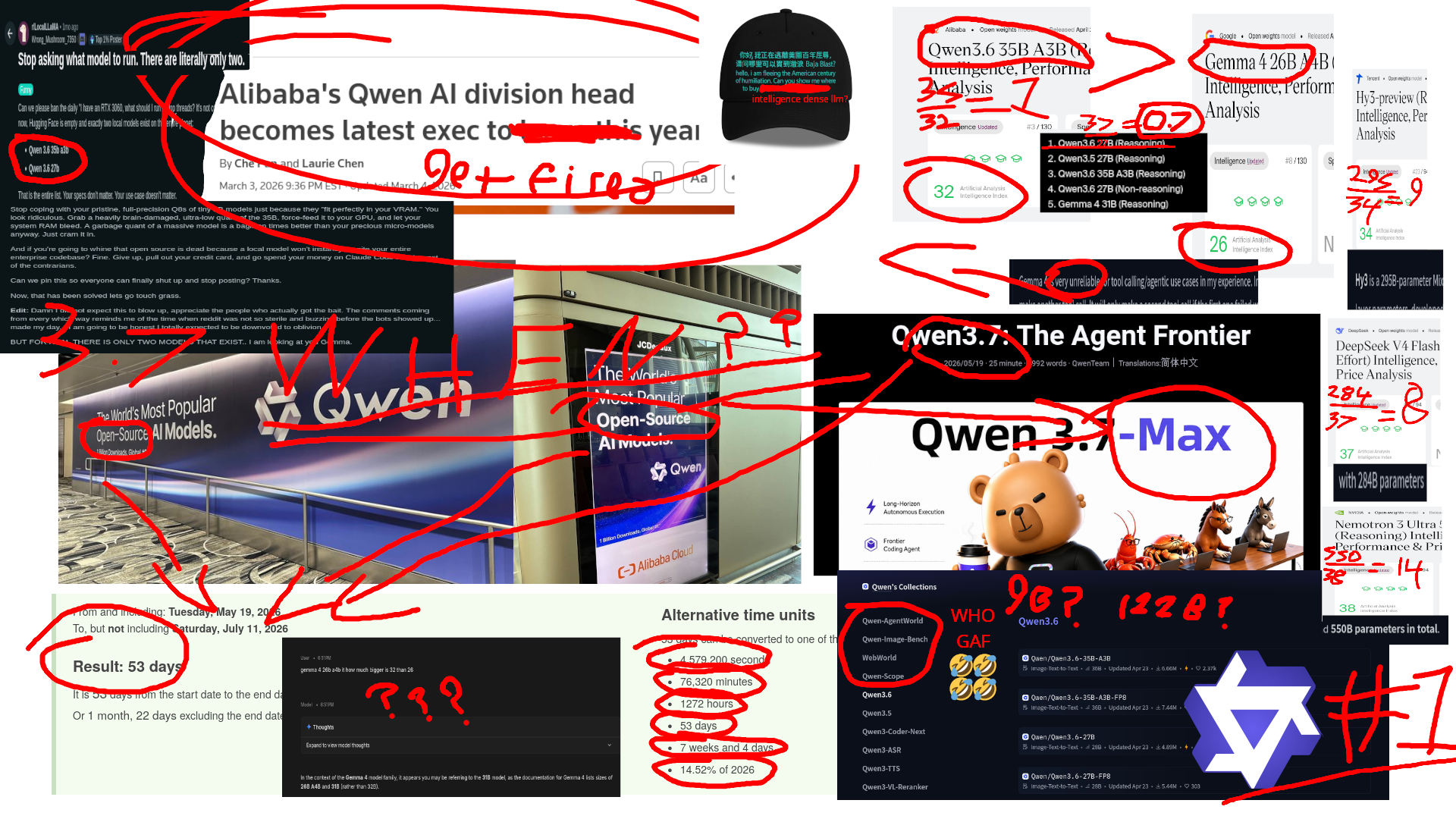
Here’s some websites you can use open weight models (in the cloud) for free on
https://huggingface.co/chat/ (personally never used it, but the free tier offered me Kimi k2.6 by default and it was super fast so /shrug)
https://openrouter.ai often offers preview models, these are not all necessarily open though, watch out.
(Maybe if you’re struggling with the local models, you can ask one of these for help :p)
tl;dr Moral crusading “anti-AI butlerian jihad” over fictional issues instead of promoting true alternatives is giving billionaires the cover they need to try to control everyone, and they’re putting all of our lives at risk. Frontier labs are not your friend.
And that is what I meant by the bold title, I hope you can see what I’m seeing. We’re in for a rough ride no matter which way this goes.
Final notes
- I never mention Google anywhere here, they seemingly still do have internal race mentality from interviews I could find, but their actions don’t show it. They’re evidently prioritizing “AI as a product” over “AI as a race” as shown by their… well poor models, and heavy focus on efficient in-house hardware. They even have a line of open source models (They weren’t truly open until Gemma 4, but I see no reason for them to backtrack that). While no massive company is your friend, they are taking this all far more responsibly than everyone else. If you can’t convince someone to use open models over closed ones for whatever reason, at least try to get them on Gemini.
- xAI (Now SpaceXAI, ugh) doesn’t get the time they deserve here, they have the same mindset Anthropic and OpenAI do, and they’re selling compute to them. Maybe I would’ve mentioned them more if they weren’t behind.
- Nvidia was never mentioned because they aren’t particularly insane. While there is something to be said about standing to the sidelines and selling shovels to anyone, regardless of their sanity, we should go after the biggest issues first.
- I never mentioned this anywhere, but the water usage arguments are also doing nothing politically, there’s no good side to them ignoring their harm. Politicians just ignore them because they’re blatantly untrue. So the claim that they are purely advantageous to billionaires mostly holds up, it’s a loud minority, and good public sentiment was never their goal anyways.
- I don’t think that billionaires are the source of the “AI uses water and IP law” messaging. I don’t find it entirely impossible, but I don’t believe it to be the case and there’s no evidence to support that it is. Instead, I believe it’s mostly a social phenomenon, using liberal and vaguely leftist politics in very broad, emotionally charged, and informationless arguments in order to socially outcast anyone who disagrees. I mean, stealing water from poor children and stealing from the poor artists would be bad if any of it were true. Plenty of supposed communists and anarchists are arguing for IP law. You know that’s an economic right wing position, right? And if you do support IP law, open source models would still be better than closed ones on that, just saying. Everyone wants to “stick it to the man”, but if you’re just spreading reactionary misinformaiton to do so, you’re really not.
- I am not a writer, I know this was written like an elementary schooler wrote it, don’t @ me.